
The Unexpected Trauma of Lovecraft Country
Written by: Ajeé Buggam
Since magic belongs to us, we should rewrite how racism is presented on the big screen.
From being terrified by the nocturnal beasts to the harsh reality sundown towns during the Jim Crow era, HBO’s Lovecraft Country had me on the edge and under my covers the entire series. I’m not a big lover of horror shows or films — the most I usually watch are psychological thrillers — but once I heard all the rave about Lovecraft Country, I had to tune in. Plus, I love witnessing more Black women direct and produce groundbreaking shows and movies.
But as I began watching the series, my heart felt shaken. Though it’s a fictional series, it references so many hard facts about the Black experience during the 1950s. I could barely focus on the monsters because the scarier part was racism, and it’s still a significant struggle Black people face today.
Revising the Literary Horror Canon
Lovecraft Country is an HBO series created by Misha Green and inspired by Matt Ruff’s 2016 novel, of the same title. Ruff’s novel was based on H.P. Lovecraft, an author with an extremely racist perspective of modern horror in the 20th century. Ruff’s novel used Lovecraft’s themes like the cost of magic and aesthetics — nocturnal, multi-eyed monsters — to create a courageous narrative about the very Black people H.P. Lovecraft’s work berated, while simultaneously expanding the Black horror canon.
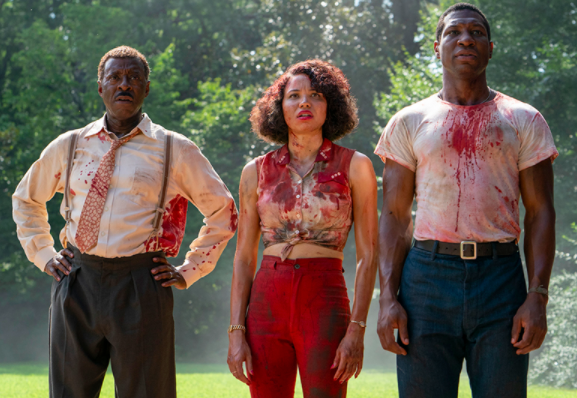
In the series, we find Atticus’s (Jonathan Majors) on a journey with Uncle George (Courtney Vance) and Letitia “Leti” (Jurnee Smollett) to find Atticus’s father Montrose (Micheal K. Williams). Uncle George leads the way as part of a “guide trip,” where he compiles a travel guide for Black folks, similar to Victor Hugo Green’s Green Book, published between 1936 and 1966. The Green Book travel guide listed businesses and towns friendly to Black travelers and helped them navigate dangerous regions, like sundown towns depicted in Lovecraft Country.
My heart was in my mouth as I watched them drive at the slow speed limit while being chased by a racist sheriff out of the “Sundown Town,” an all-white town in which Black people were at risk of violence after dark or after the sun set. I was too angry and could barely get over this scene even after nocturnal monsters sprawled out of the forest roots, because the real horror is that sundown towns still exist in America today.
Medical Apartheid is Scarier Than a Haunted House
As we spiral into the magic, Atticus, Leti, Uncle George, and Montrose know magic exists, but they don’t know how to conduct spells until later in the show. The group with the most power are the white characters, Christina Braithwhite (Abbey Lee Kershaw), her boyfriend William (Jordan Smith), and her father, Samuel Braithwhite (Tony Goldwyn). Samuel invites his prestigious white friends — part of an secret group called the Sons of Adam — to his lodge to watch Atticus, Leti, and Uncle George get tormented based on delusional spells Christina put on them. The scene reminds me of Jordan Peele’s Get Out, the psychological thriller that explored the manipulation and fetishizing of Black people.
In another episode, Leti buys a house in a predominantly white neighborhood. The house turns out to be haunted by several ghosts, including a white doctor who performed horrifying experiments on Black people. I watched most of this scene with one eye and hiding under the covers. Again, it’s fictional, but the realities of experimentation were too vivid. One of the ghosts is named Anarcha, a nod to the real experience of a slave who encountered surgery without anesthesia by Dr. J. Marion Sims, which earned him the title of the father of modern gynecology.

Photo of Ruby (Wunmi Mosaku) (HBO)
We watch Ruby (Wunmi Mosaku), Leti’s sister, and Christina experience major shapeshifting power dynamics based on a poison Christina creates. Christina shapeshifts into being William, a white man obtaining the highest form of power. After taking the potion, Ruby awakes and learns she has shapeshifted into a white woman, taking on privileges (like reading a newspaper in the park) that weren’t allowed to Black people during the time. Seeing this transformation was mind-blowing as Ruby tried to exploit her power to speak up for Black people in white spaces behind closed doors. The episode highlights the pain of codeswitching and pretending to be someone you’re not for professional and social gain. Both Ruby and Christina use their newfound positions of power selfishly, but Ruby also tried to challenge systems. And thanks to this episode, we’ll never look at red bottoms quite the same.

Dee (Jada Harris) (HBO)
We run into a huge real-life flashback of the brutal murder of 14-year-old Emmett Till, also known as “Bobo,” who is Dee’s (Jada Harris) best friend. Dee runs away completely frustrated with her life, and two white sheriff cops put a spell on her, and she’s haunted by twin girls that were inspired by Freddy Krueger and Topsy from Harriet Beecher Stowe’s novel, Uncle Tom’s Cabin. Misha Green mentions, “Reading the devil doll chapter in Matt Ruff’s novel and being a huge fan of A Nightmare on Elm Street, I wanted to create our version of Freddy Krueger.” We watch Dee run away from Topsy and Bopsy while snippets from a speech by Naomi Wadler play in the background. As gruesome as this episode was, there is a clear, unsettling message about how society ignores Black girls.
Other episodes explored the Tulsa race massacre — the downfall of Black Wall Street and the deaths of at least 300 Black people by racist white mobs — erasure and brutal violence against Indigenous peoples, shame and silence around sexuality. We see a terrified Montrose witness the brutal slaughtering of his friend and potential lover by a white mob as the Tulsa massacre begin. As pieces are put together about Montrose’s upbringing as a kid, outward aggression as an adult — namely towards his son, Atticus — his story conveys another harsh reality that there is little room for vulnerability and sexual exploration for Black men.
I can say the series got some things right. In one episode, the character Hippolyta (Aunjanue Ellis) explores many parts of history and finds her worth beyond being a care provider for her family by naming herself anything her heart desires — though, in the end, she still chooses her family. This episode hit home because I’ve seen many Black women give selflessly to others throughout their lives to others but leave little to no space to pour that same kind of love on themselves. Hippolyta got to dance on set amongst legendary and super liberal Josephine Baker in Paris. She became a Dahomey warrior — the group of women which inspired the Black Panther’s Dora Milaje — and even a superior explorer and astronomer. This was such a breathtaking scene seeing Hippolyta so alive and discovering her voice and purpose.
Now That Magic Belongs to Us
Overall, Lovecraft Country was such a powerful series amplifying the Black experience, full of educational and historical experiences before and during Jim Crow. But I’m tired of seeing movies or shows that resurrect Black oppressive trauma in disguise as entertainment. There has to be a higher level of accountability around the content being produced and how it affects the Black community. Many episodes were thought-provoking, but others, like the Tulsa episode, were just heavy and weary.
As the series progresses — and since “magic is ours now” — I hope to see some racism altered, so it’s less brutal and traumatizing to watch. I know tragedy makes the show juicy, I just hope it is not at the expense of Black lives.
I’m elated to see more Black directors and producers creating profound narratives that speak to our experiences and creating horror/sci-fi content for the big screen. There is literally no other show I’ve seen in comparison to this show. As painful as it is to watch how racism is woven into the horror, the show broke so many boundaries and intertwined factual events with a fictional flare so profoundly.





Alex Elle is the author of multiple books, host of hey, girl podcast, wellness consultant, and instructor of writing retreats and workshops. And her latest book, After the Rain, explores obstacles, confidence, and abundance.