
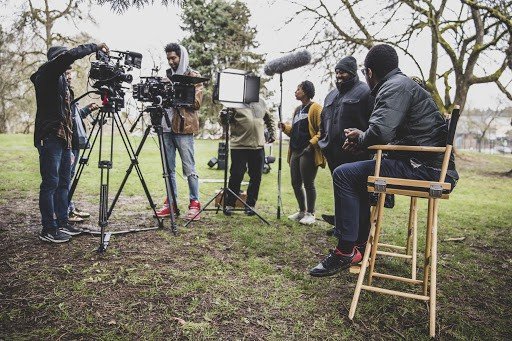
Movies on the Margins: The Legacy of Black Independent Cinema
Written by: Kaila Cherry
The film industry has tried to erase contributions from Black folks since its beginning. Black people have been making movies since the early 1900s. Pushed out of white Hollywood, however, Black filmmakers went on to create their own production companies, work with their own resources, and tell the story of the Black experience in groundbreaking ways. From Oscar Micheaux to Melvin Van Pebbles to Ava DuVernay, it is time to position Black people at the center of the independent film movement in America that we are so often excluded from.
The impetus for Black independent film making came as a response to the misrepresentation of Black folks and Black culture by white artists. From the tail end of the 1800s to the end of the 1930s, Black people in movies were depicted through white actors in blackface. Adorned in greasepaint, white actors mocked and exaggerated the speech and mannerisms of Black people. This form of entertainment, minstrel shows, was widely popular in theatre starting in the 1830s and made the transition to film seamlessly.
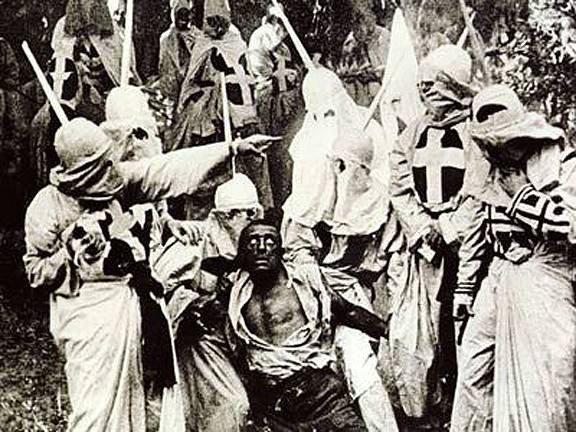
Scene from The Birth of a Nation with a white actor in Blackface surrounded by the KKK.
D.W. Griffith’s 1915 Civil War drama The Birth of a Nation is the most notable example of Black misrepresentation through cinema. The film tells the story of the relationship between a Yankee and Confederate family both during and after the Civil War. The Birth of a Nation was heavily in favor of the South and sought to reinvigorate nationalism in the region 50 years after their loss to the North. Griffith does this by showing Black people, specifically Black men, as lazy, drunk, fried-chicken-and-watermelon-eating rapists. Blatant racism is encouraged through Griffith’s stylization of the Ku Klux Klan as America’s hooded and cloaked crusaders of justice by keeping the “unruly Negro” in line. In fact, The Birth of a Nation’s depiction of the Ku Klux Klan was so attractive to white supremacists that the actual Klan adopted the style and rituals of their fictional counterparts. The burning of the cross was no longer a figment on the screen.
The horrible depiction of Black people in The Birth of a Nation coupled with the film’s incredible success in spite of it’s blatant racism mobilized Black artists to carve a path in the film industry for themselves. The first known Black feature filmmaker in the United States is Oscar Micheaux. In 1919, Micheaux released The Homesteader, the first feature film with an all Black leading cast. Based on events from his actual life, The Homesteader presented an earnest view of Black rural life that was not present in films at the time. From then on, Micheaux made over 40 of his own movies, referred to as “race films” due to their majority black casts and black audiences. His films focused on subverting the stereotypical and offensive imagery of Black people by making his characters motivated self-starters unable to thrive in society under the plight of racism.
With Micheaux as the blueprint, Black independent films continued to expand. In 1941, Spencer Williams wrote, directed, and produced the film The Blood of Jesus under his own production company. With only a budget of $5,000 and a cast of nonprofessional actors, William’s fantastical narrative of a Black woman’s fight for the salvation of her dying soul was a massive success and is recognized by many film critics as the greatest race film of all time. Unfortunately, subsequent films by Williams were not received as favorably as The Blood of Jesus. Because of this, Spencer Williams turned to acting in 1951, playing the lead role of Andy in the radio program turned CBS sitcom, Amos ’n’ Andy.

The Blood of Jesus (1941) Directed by Spencer Williams
The creation of race films ended in the 1960s. In the decades following World War II, the conventions of film making were being challenged all over the world. Subversive film movements most often acknowledged for this time period are Italian Neorealism (1943–1952) and the French New Wave (1958-late 1960s). These movements are credited with influencing American independent filmmakers of the mid 1960s to early 1980s. Known as “New Hollywood,” the directors given the most credit for shaping independent film in the United States are George Lucas, Martin Scorsese, and Steven Spielberg. Alumnus of private university giants New York University and the University of Southern California, those three filmmakers were poised to break into the industry.

Killer of Sheep (1976) Directed by Charles Burnett
At the University of California, Los Angeles, however, a striking experimental film program had emerged in the shadows. For nearly a decade, Black students out of UCLA’s Theatre, Film, and Television program aimed to bring a new kind of social consciousness to the screen. These filmmakers accomplished this by showing authentic stories of Black life, Black struggle, and Black radicalization through plots and characters, and through avant-garde. Known as the L.A. Rebellion, this movement of Black independent filmmakers influenced by political, racial, and economic upheaval during the late 1960s included directors like Charles Burnett, Julie Dash, Haile Gerima, and Dee Rees.
Around the same time, another Black independent film movement shot into popularity with Black audiences. In 1971, Martin Van Peebles released the movie Sweet Sweetback’s Baadasssss Song. Written, directed, produced, edited, and starring Van Peebles, Sweet Sweetback’s Baadasssss Song chronicles the life of Sweet Sweetback, a man on the run from corrupt white police officers after being framed for a crime he did not commit. Filled with fast paced editing, funky music, gratuitous sex, absurd violence, and biting indictments of systemic racism all made on a minuscule budget, Sweet Sweetback’s Baadasssss Song became the foundation for the Blaxploitation genre. The film was followed by the release of Shaft, directed by Gordon Parks, in the same year and Blaxploitation became an instant fad.

Opening Credits to Sweet Sweetback’s Baadasssss Song (1971) Directed by Melvin Van Peebles
Blaxploitation peaked in popularity in the mid 1970s and declined soon afterwards. By the end of the decade, Blaxploitation films had mostly ceased production. However, their impact had a lasting effect on the next generation of Black independent filmmakers to come. After releasing a few short student films to critical acclaim, New York native Spike Lee wrote and directed his first feature film She’s Gotta Have It in 1985. Under his own production company 40 Acres and a Mule Filmworks, Lee shot the film over the course of two weeks with a budget of $175,000. When She’s Gotta Have It was released in 1986, it was well received by audiences who admired Lee’s depiction of Black female agency and Black life in New York City.
After She’s Gotta Have It, Spike Lee began to embark on the creation of his second feature film. This time, not only was his budget much higher than it was for She’s Gotta Have It, but his second film was to be distributed by Universal Pictures. Released in 1989, Spike Lee’s seminal project Do The Right Thing took the American public by storm. Chronicling the mounting racial tensions in a Brooklyn neighborhood during the summertime, Do The Right Thing was groundbreaking and full of vibrancy as it artfully tackled the complex topic of race relations in the United States. Do The Right Thing was nominated for Best Original Screenplay at the 1990 Academy Awards but lost to the writer of Dead Poets Society (1989).
As Spike Lee continued to establish himself as a canonical filmmaker throughout the 1990s, younger independent filmmakers sprouted. Julie Dash from the L.A. Rebellion released Daughters of the Dust in 1991. Daughters of the Dust was the first film directed by a Black woman in the United States to have a nationwide theatrical release. In 1993, Allen and Albert Hughes released the gritty coming-of-age drama Menace II Society, which follows the story of two Black teenage boys in Watts, California. Menace II Society shocked audiences with its raw representation of the life of Black youth that would later be appropriated in the white cult film, Kids, released two years later.

Daughters of the Dust (1991) Directed by Julie Dash
In 1997, Black lesbian filmmaker Cheryl Dunye released her debut feature film The Watermelon Woman. A landmark piece, The Watermelon Woman was the groundwork for the New Queer Cinema movement that emerged in the late 1990s and into the new millennium. Dunye’s film addresses the intersections of Blackness, female identity, sexuality, and misrepresentation in media through the main character’s journey to make a documentary film about uncredited Black women from movies of the 1930s and 1940s. The Watermelon Woman is refreshingly self-referential in its critiques of the treatment of Black women — especially Black queer women — within the film industry. With only a budget of $300,000, The Watermelon Woman remains an essential piece of viewing for Black women looking for real representation in all aspects of cinema, from acting on screen to production and editing.

The Watermelon Woman (1996) Directed by Cheryl Dunye
Today, Black independent filmmakers have received more attention and respect from white Hollywood than ever before. Filmmakers such as Ava DuVernay, Ryan Coogler, and Barry Jenkins are just three of many Black filmmakers who began their careers as independent creators and eventually broke into the mainstream film industry. Ava DuVerney went from establishing her own distribution company in 2011 to directing blockbusters and getting Oscar nominations. Ryan Coogler went from directing the heart wrenching 2013 film, Fruitvale Station, based on the murder of Oscar Grant to directing Marvel’s widely successful Black Panther in 2018. Barry Jenkins moved audiences in 2016 with his film Moonlight that went on to win Best Picture at the 2017 Academy Awards.
On Juneteenth this year, Black Artists for Freedom launched. Signed by over 1,000 different artists including filmmakers, Black Artists for Freedom is a collective that aims to eliminate racism in our society by uplifting Black artists and the culture we create. The Black Artists for Freedom collective calls on the art world to give space and resources to Black artists in order to uplift their perspectives, honor their creativity, and give them agency in their representation.
This is where Black independent film making stands today. We are experiencing a cultural shift in which Black stories told by Black people for Black people that challenge conventional cinema are being sought after. There is a hunger not only from the Black community, but the general public as a whole to see something new, fresh, and poignant that does not try to diminish the complexities of life.
As an aspiring filmmaker, I have seen how my white colleagues move through the film industry with so much more ease than I have. However, I am optimistic about my future. The independent Black filmmakers of the past have set the foundation for my generation. I cannot wait to see what I will create. I cannot wait to leave my mark on film history.






Alex Elle is the author of multiple books, host of hey, girl podcast, wellness consultant, and instructor of writing retreats and workshops. And her latest book, After the Rain, explores obstacles, confidence, and abundance.